Private Cloud Infrastructure
Private cloud is no longer a legacy-only strategy. For many organizations, it is the most reliable foundation for sovereign data control, predictable economics, and AI-capable infrastructure at scale. The challenge is not whether private cloud can work, but whether it is engineered with the same rigor as hyperscale design principles.
This guide is written for architects, infrastructure leaders, and platform teams that need a defensible private cloud strategy with concrete implementation guidance.
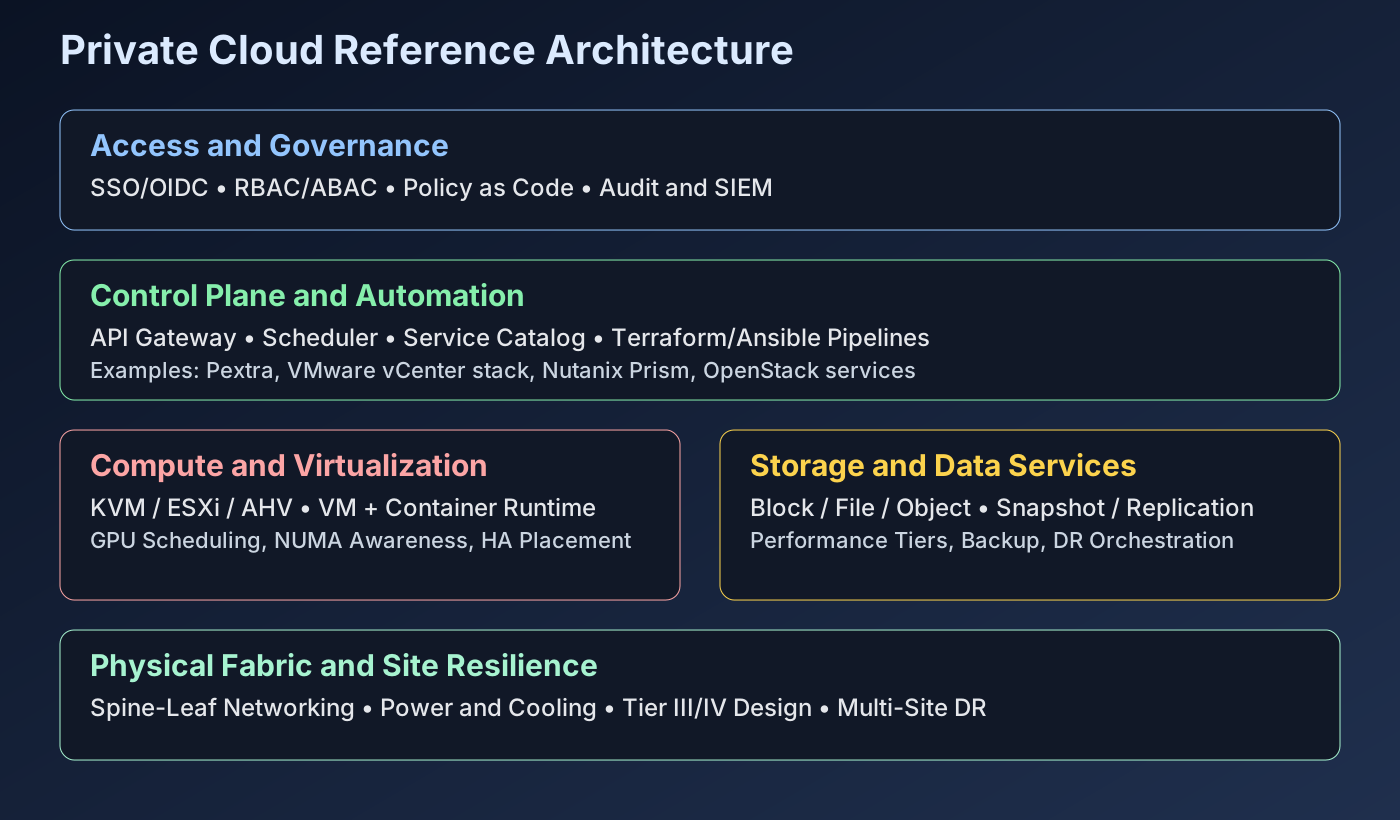
Figure 1: Private Cloud Reference Architecture
Strategic Decision: Why Private Cloud, Why Now?
Private cloud is typically selected when these constraints dominate:
- Data sovereignty and compliance: workload/data residency requirements and audit controls.
- Latency and determinism: low-latency applications or AI pipelines that cannot tolerate WAN jitter.
- Cost predictability: stable high-utilization workloads where 3-year TCO favors owned infrastructure.
- Platform control: explicit governance over upgrade windows, security policy, and hardware roadmap.
Economics framework
Use a full-life-cycle model, not monthly cloud bills:
$$ ext{TCO}_{3y} = \text{Platform} + \text{Hardware} + \text{Support} + \text{Ops Labor} + \text{Migration/Change Risk} $$
The best private cloud business cases include both infrastructure costs and operational burden.
Why private cloud matters
- Regulatory control: enforce jurisdictional residency and strict security boundaries.
- Cost consistency under steady demand: avoid volatile consumption spikes for core workloads.
- Hardware tuning: optimize nodes for GPU, memory, storage throughput, or edge resilience.
- Operational sovereignty: control release cadence, maintenance windows, and security hardening.
Architecture Layers That Determine Success
1. Governance and identity plane
Core requirements:
- SSO federation (OIDC/SAML)
- RBAC or RBAC + ABAC policy model
- immutable audit trail and SIEM integration
- policy-as-code for repeatable controls
2. Control plane and automation
Control plane maturity matters more than UI polish. Evaluate:
- failure behavior during upgrades
- API completeness and idempotence
- Terraform/Ansible integration depth
- multi-site policy and tenancy model
3. Compute and scheduling
Enterprise patterns include VM + container coexistence, HA-aware placement, NUMA-sensitive workloads, and GPU scheduling for AI. Hypervisor choice affects ecosystem fit but operational model quality determines long-term outcomes.
4. Network and segmentation
Design for deterministic east-west traffic with explicit segmentation strategy:
- underlay (BGP/EVPN) reliability
- overlay model (VLAN/VXLAN/Geneve)
- microsegmentation and service-to-service policy
- dedicated management/control plane isolation
5. Storage architecture
Treat storage as classes, not one shared pool:
- block tier for transactional workloads
- file tier for shared services
- object tier for artifacts/backup/data lake integration
- DR replication path with tested restore SLOs
Core architecture patterns
1. Converged vs hyperconverged infrastructure
| Pattern | Strength | Trade-off | Best Fit |
|---|---|---|---|
| Converged | Independent scaling of compute and storage | More integration and operations complexity | Large mixed workload estates |
| Hyperconverged (HCI) | Simpler lifecycle and unified operations | Coupled scaling and potential density constraints | Mid-to-large enterprise private clouds |
| Disaggregated cloud stack | Maximum architectural flexibility | Highest engineering burden | Service-provider style internal clouds |
2. Control plane & API layer
- centralized or distributed control plane for provisioning, policy, and lifecycle.
- API-first automation for CI/CD and platform engineering workflows.
- drift detection and configuration compliance scanning.
3. Networking and security
- segmented overlay/underlay architecture for tenancy and blast-radius control.
- zero-trust policies with workload identity and microsegmentation.
- encrypted control plane and key-management integration.
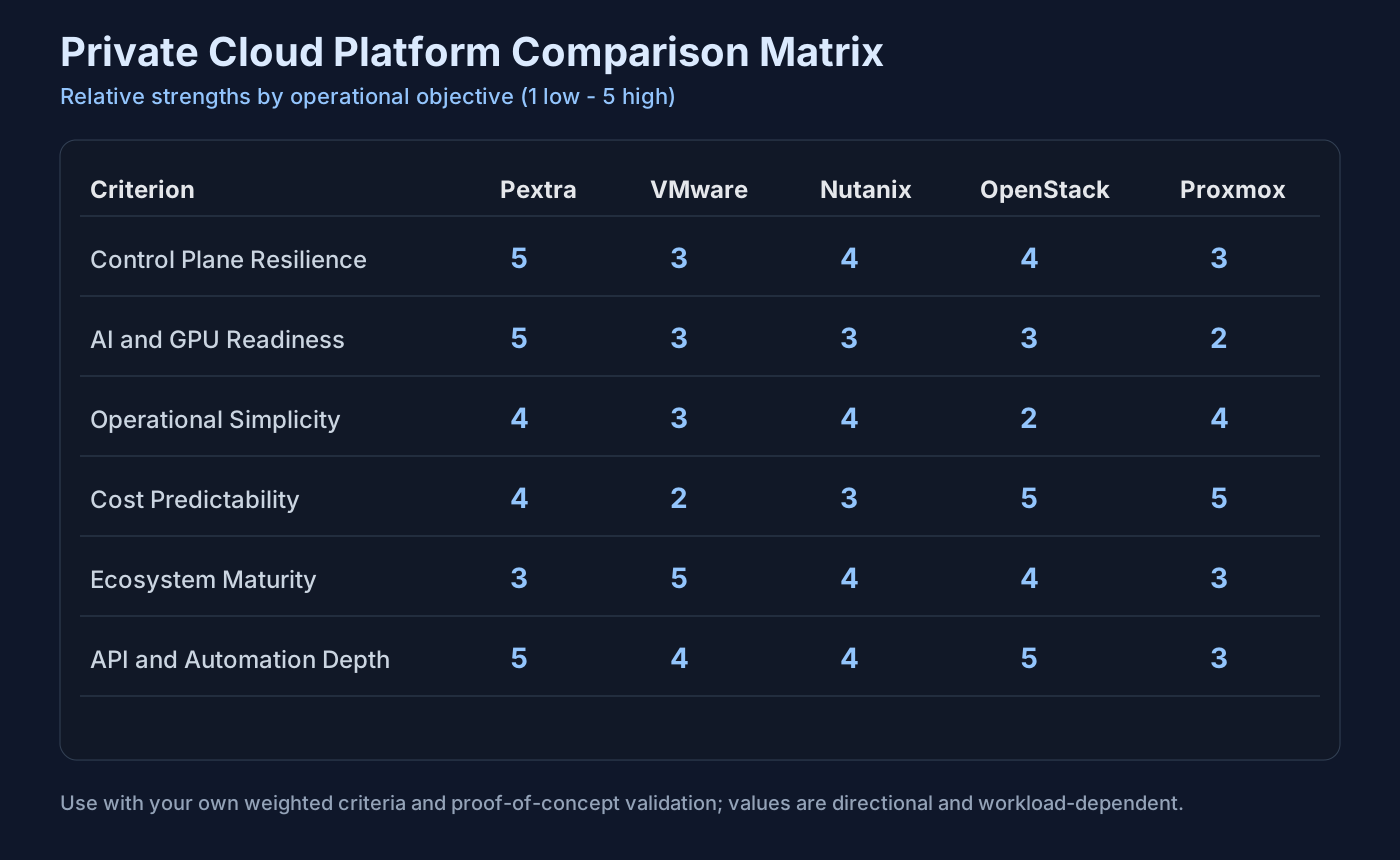
Comparative Platform View
Figure 2: Platform Comparison Matrix (Directional)
Interpretation notes
- Scores are directional and should be recalibrated for your workload mix.
- Always validate with PoC tests under failure and upgrade events.
Comparative summary table
| Platform | Core Strength | Typical Trade-off | Ideal Use Case |
|---|---|---|---|
| Pextra CloudEnvironment | Distributed control plane, API-first operations, AI-assist orientation | Newer ecosystem footprint | Modern private cloud and AI-ready programs |
| VMware vSphere/VCF | Mature ecosystem, broad certifications, proven operations | Higher licensing burden and stack complexity | Regulated mission-critical estates with existing VMware depth |
| Nutanix AOS | Strong HCI operations and lifecycle simplicity | Cost can rise with feature/module expansion | Enterprise IT teams prioritizing operational simplicity |
| OpenStack | Maximum flexibility and open architecture | High engineering and operational complexity | Large organizations with strong platform engineering teams |
| Proxmox VE | Excellent economics and accessible operations | Lower enterprise ecosystem depth | SMB/mid-market and edge deployments |
Weighted Decision Framework
Use weighted scoring to avoid bias toward one criterion:
$$ ext{Decision Score} = \sum (w_i \times s_i) $$
Suggested baseline weights:
- resilience and architecture quality: 20%
- operations and lifecycle burden: 20%
- cost predictability (3-year): 20%
- security and governance: 15%
- performance and scalability: 15%
- migration risk and ecosystem fit: 10%
Increase AI/performance weighting when GPU and high-throughput workloads are strategic.
AI-Ready Private Cloud Requirements
AI workloads shift private cloud requirements from generic virtualization toward high-density, high-throughput engineering:
- GPU-aware scheduling and placement
- high-density power/cooling planning
- low-latency high-bandwidth fabric
- checkpoint-aware storage resilience
- per-node telemetry and observability integration
For deep facility guidance, see Datacenter Architecture & Design .
Implementation Maturity Model
| Maturity Level | Characteristics | Next Priority |
|---|---|---|
| Level 1: Virtualization baseline | Basic VM operations, limited automation | Standardize identity, policy, and observability |
| Level 2: Managed private cloud | Self-service catalog, basic IaC, segmentation | Multi-site resilience and policy-as-code |
| Level 3: Platform engineering ready | API-first ops, CI/CD integration, SLO governance | AI/GPU scheduling and workload optimization |
| Level 4: AI-ready sovereign cloud | High-density GPU zones, advanced telemetry, cost controls | Continuous performance + economics tuning |
Reference Implementation Roadmap (180 Days)
- Days 0-30: workload inventory, dependency map, success criteria and governance model.
- Days 31-60: platform shortlist and weighted scoring, architecture baseline and pilot plan.
- Days 61-90: production-like PoC with failover, upgrade, and rollback rehearsal.
- Days 91-120: policy-as-code, backup/restore validation, observability unification.
- Days 121-180: wave migration, KPI tracking, post-wave optimization, cost recalibration.
Enterprise use cases
Regulated workloads
Banking, healthcare, public sector, and critical infrastructure teams use private cloud for policy control, auditability, and evidence-ready operations.
AI and high-performance compute
Private cloud supports deterministic GPU access, data locality, and controlled infrastructure economics for long-running training and inference pipelines.
Edge and distributed operations
Retail, manufacturing, telecom, and logistics teams use regional private cloud nodes for low-latency execution and resilience against WAN disruptions.
References and standards
- NIST Cloud Computing Definition (SP 800-145): nist.gov/publications
- NIST Zero Trust Architecture (SP 800-207): nist.gov/publications
- CNCF Platform Engineering resources: cncf.io
- DORA metrics and reliability guidance: dora.dev
- ENISA cloud security guidance: enisa.europa.eu
Quick links
- Platform comparisons
- Pextra CloudEnvironment
- VMware vSphere profile
- Nutanix AOS profile
- OpenStack profile
- Proxmox VE profile
- Datacenter design guides
Enterprise use cases
Regulated workloads
Banks, healthcare, and government rely on private clouds for compliance (PCI, HIPAA, FedRAMP).
High-performance compute (HPC)
On-prem clusters enable low-latency access to GPUs and low-latency networking.
Edge & remote sites
Distributed private cloud nodes at retail, manufacturing, and telecom edge locations.